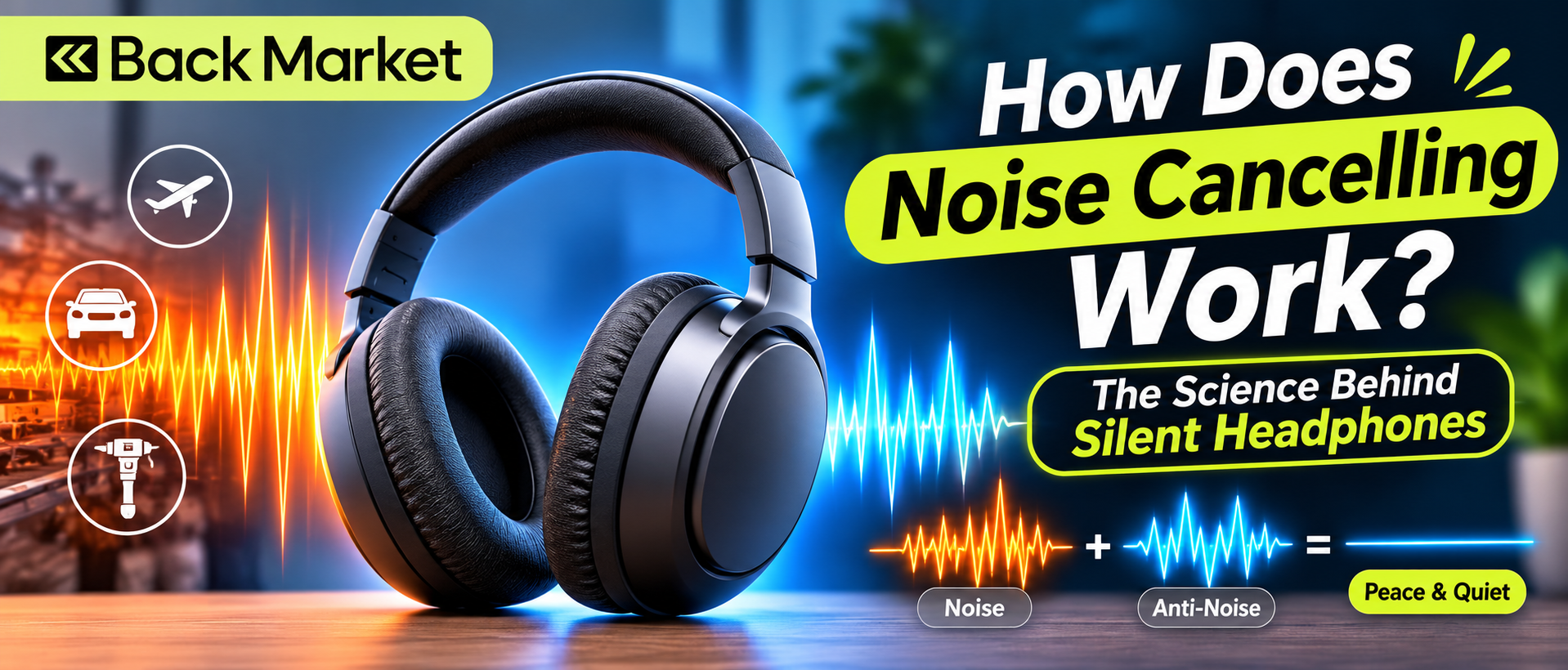
How Does Noise Cancelling Work? The Science Behind Silent Headphones
Deepansha
Nov 19,2026
Introduction
🎧 Shop noise cancelling headphones nowI still remember my first long flight with a pair of noise cancelling headphones. The engines were roaring, a toddler two rows back had opinions, and then I pressed one tiny button. Silence. Well, not total silence, but close enough that I actually checked whether the battery had died. So, how does noise cancelling work? It feels like magic, but it's really clever physics, a few small microphones and a very fast chip. Want to try it without paying the flagship price? Back Market has refurbished noise cancelling headphones worth a look.
How Does Noise Cancelling Work? The Short Answer
Here's the quick version. Noise cancelling headphones listen to the noise around you, then play a mirror image of that noise into your ears. When the original sound and the mirrored sound meet, they cancel each other out. That's it. The result is that the droning hum of a plane, a bus or an air conditioner gets a lot quieter, even though the headphones aren't "blocking" it in the traditional sense.The official name for this is active noise cancellation, or ANC. The word "active" matters. The headphones are doing real work with electronics and power, not just sitting on your ears like a pair of fluffy earmuffs. We'll get to that difference soon.
Understanding Sound Waves: The Part That Makes Everything Click
To understand noise reduction technology, you have to understand sound waves first. Don't worry, it's not scary.Sound is just air pressure changing very quickly. A speaker, a voice, a jet engine, they all push air molecules together (high pressure) and then let them spread out (low pressure). Draw that pattern on a graph and you get a wavy line. The peaks are the high pressure bits. The valleys are the low pressure bits.
Now imagine a second wave that's the exact opposite. Where the first one has a peak, the second has a valley. Put them together and the peak fills the valley. Flat line. No pressure change, so no sound. Scientists call this destructive interference, and it's the heart of the whole thing.
It's a bit like two people pushing a swing at the exact same moment, but from opposite directions. Nothing moves. Funny, right?
Headphone Microphones: The Tiny Listeners
So how do the headphones know what noise to cancel? Through headphone microphones. Tiny ones, usually about the size of a grain of rice, sitting in small holes on the outside of each ear cup. Some models have two or three per side.These mics constantly pick up the ambient sound around you. Traffic rumble, office chatter, the whoosh of a train. That signal goes straight to a small processor inside the headphones, which is the real brain of the operation. If you ever look closely at a pair of Sony WH-1000XM series or Bose QuietComfort headphones, you can spot the little mic ports if you squint.
The processor has one job: analyze the incoming sound and decide what the opposite wave should look like. And it has to do it in a fraction of a millisecond. Too slow, and the anti-noise lands at the wrong moment and actually makes things worse.
How Does Active Noise Cancellation Work, Step by Step?
Let's slow it down. Here's what happens every time you switch ANC on.- Step 1: Listening: The outside microphones capture the surrounding noise.
- Step 2: Processing: The chip analyzes the shape, pitch and strength of that noise.
- Step 3: Flipping: It creates a new signal that is phase-inverted, meaning shifted by 180 degrees. Peaks become valleys.
- Step 4: Playing: The headphone driver (the little speaker inside) plays this anti-noise along with your music.
- Step 5: Cancelling: The anti-noise meets the real noise right at your eardrum, and they largely wipe each other out.
A small bit of history, since people love it: the idea of active noise control dates back to a 1930s patent by German physicist Paul Lueg. Amar Bose, the founder of Bose, is widely credited with pushing it toward consumer headphones after a noisy flight in the late 1970s. Early versions were big, clunky and made for pilots. Now they fit in your jacket pocket.
Types of ANC Technology: Feedforward, Feedback and Hybrid
Not all ANC technology is built the same way. There are three main designs, and the difference shows up in real life.Feedforward ANC puts the microphone on the outside of the ear cup. It hears the noise before it reaches you, which gives the chip a head start. It's good at catching sounds early, but it can be a bit sensitive to wind.
Feedback ANC puts the microphone inside the ear cup, right next to your ear. It hears what you actually hear, including leftover noise, and corrects it. It's precise but works over a smaller range of frequencies.
Hybrid ANC uses both. Outside mics catch the incoming noise, inside mics check the result and fine tune it. Most good modern headphones go this route, because it gives the strongest and most stable cancellation.
If you're shopping and see words like "dual" or "adaptive" noise cancelling, that's usually a hybrid setup with extra software on top. Some models even test the shape of your ear and the seal of the cushions and adjust themselves. A bit creepy, a bit brilliant.
Active vs Passive Noise Cancellation: What's the Difference?
This is where people get confused, so let's be clear. Active vs passive noise cancellation is basically electronics versus materials.Passive noise cancellation is the physical barrier. Thick ear cushions, a snug seal, dense padding, or ear tips that sit inside your ear canal. It works with no battery at all. Think of earplugs at a concert, or the foam on a pair of studio headphones. It's great at blocking higher pitched sounds like voices, keyboard clicks and a barking dog.
Active noise cancellation is the electronic system we just walked through. It's brilliant at steady, low pitched sounds like engine hum, fans and road rumble.
And here's the thing: they work best together. ANC vs passive isn't really a fight. A good ANC headphone depends on a solid physical seal, because the better the passive layer, the less work the electronics have to do. That's why a cheap pair with great software can still sound disappointing if the ear cushions leak.
So if someone tells you ANC replaces good fit, they're wrong. Don't believe them.
What Noise Reduction Technology Can and Can't Do
I'll be honest, this is the part most product pages skip. ANC isn't a force field.It does well with predictable, repetitive sounds. A plane cabin, a bus, a washing machine, a noisy fridge. Many headphones reduce this kind of noise by a very noticeable amount, often described as roughly 20 to 30 decibels in the low frequencies, though results vary by model and fit.
What it struggles with is sudden, sharp sounds. A dropped plate. A door slam. Someone shouting your name. The chip simply can't predict those fast enough to build a matching wave. Human speech is also tricky because it jumps around in pitch constantly. You'll still hear a murmur of conversation, just softer.
A few other quirks worth knowing:
- Some people feel a slight pressure in the ears, almost like being underwater. It's not harmful, just odd. It happens because your brain isn't used to the low frequency quiet.
- ANC uses a battery, so expect fewer hours than with it switched off.
- Wind can cause a faint rushing sound on outdoor walks, since the mics catch gusts.
Transparency Mode: When You Want the World Back
Once you've lived with the ANC for a week, you realize something. Sometimes you really do need to hear things. A train announcement. A coffee order. Your kid asking if dinner's ready.That's what transparency mode is for. Sometimes it's called ambient mode or hear-through. The same outside headphone microphones pick up the world, but instead of cancelling it, the headphones play it back into your ears, usually with some filtering. It sounds surprisingly natural on good models, almost like you're wearing nothing.
Some headphones also have "conversation awareness" features that pause your music and switch to transparency when they detect you speaking. Handy when you're at the airport counter and don't want to fumble with buttons.
It's a small feature, but honestly, it's the one that makes ANC practical for city walking, cycling in quiet areas, or just working at a shared desk.
Why Travel Headphones Love Noise Cancelling
If there's one situation where ANC earns its price, it's travel. Planes, trains and buses create a constant low rumble, exactly the kind of noise active cancellation handles best. That's why travel headphones are almost always sold with ANC front and centre.The benefit isn't just comfort. When you can block a chunk of that drone, you don't need to crank your music as loud, which is kinder to your ears over the long run. Many frequent flyers also say they arrive less tired, though that's more of a personal impression than a hard rule. Fewer interruptions, less strain, more peace. On a six hour flight, that's no small thing.
For trips, look for:
- A good seal and soft, breathable cushions (airplane cabins get warm).
- Solid battery life, ideally 25 to 30 hours with ANC on.
- A compact, foldable case.
- Easy switching between ANC and transparency mode.
- Wired option or airplane adapter, if you like in-flight entertainment.
How to Choose the Right Noise Cancelling Headphones
With so many noise cancelling headphones on the market, picking one can feel overwhelming. Maybe you want over-ear. Or maybe earbuds are easier? Hmm. Here's how I'd think about it.Over-ear headphones usually cancel better because of the bigger cups, larger drivers and stronger passive seal. They're the best choice for flights and long commutes.
Earbuds are lighter and easier to carry. Modern ones are surprisingly good, especially those with silicone or foam tips that seal well.
Fit and comfort matter more than spec sheets. Try them on if you can. A pair that hurts after an hour is a pair that stays in the drawer.
Software and extras like app controls, adjustable ANC levels and multipoint Bluetooth are nice bonuses, not necessities.
Budget is flexible. Premium models from brands like Sony, Bose and Apple lead the pack, while mid-range options from Anker, JBL and others can be very decent. Read recent reviews rather than trusting one headline.
Final Thoughts
So, how does noise cancelling work? In short, microphones listen, a chip flips the sound, and the headphones play that opposite wave so the two cancel out. Add a good physical seal, and you get a quieter world with very little effort. It's not perfect, it won't erase a sudden shout, and it does lean on your battery. But for planes, trains, offices and busy streets, it's one of the most useful bits of audio tech around.If you've been on the fence, remember the basics: understand active vs passive noise cancellation, check the fit, and don't ignore transparency mode. Get those right and the silence will probably surprise you. Mine did. And if you're ready to buy, check out Back Market for refurbished noise cancelling headphones that are easier on your wallet and kinder to the planet.
🎧 Shop noise cancelling headphones now
Frequently Asked Questions
1. Is noise cancelling bad for your ears or health?
No, ANC itself isn't harmful. It uses harmless sound waves to reduce noise, and it can actually help you listen at lower volumes. Some people feel mild pressure or dizziness at first, which usually fades as they adjust. If it bothers you, try a lower ANC level or take breaks. And of course, keep the volume reasonable.
2. Can noise cancelling headphones block all noise?
Not quite. They are best at steady, low pitched sounds like engines and fans. Sudden noises and human voices usually get softer but don't disappear. Good ear cushions or tips help with the rest through passive isolation.
3. Do I need noise cancelling headphones if I mostly listen at home?
It depends on your space. If your home is quiet, you may not need ANC. If you deal with a loud street, a humming fridge, a fan or family noise, it can be a lovely upgrade. Many people also find it helpful for focus and work calls.
Recent Blogs