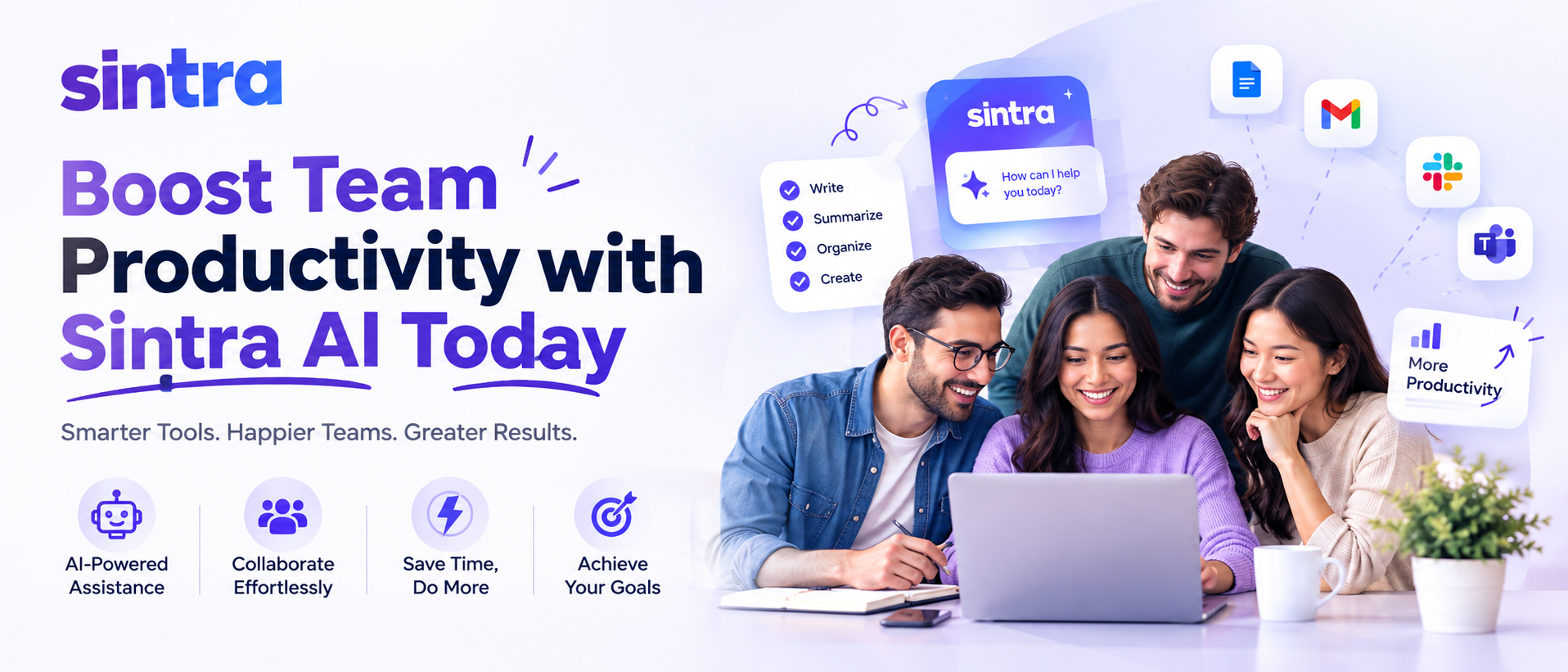
Boost Team Productivity with Sintra AI Today
Deepansha
Sep 17,2026
Introduction
Boost Productivity with Sintra AI 🚀Running a business in 2026 means juggling a dozen roles you never signed up for. Marketing one minute, customer support the next, then somehow you're also supposed to be analyzing spreadsheets before lunch. That's exactly the gap AI productivity tools are stepping into right now, and Sintra AI has become one of the more talked about names doing it. Not because it's flashy (well, it kind of is), but because it actually tries to solve the "too much to do, not enough hands" problem that most small teams live with every single day.
I'll be honest. When I first heard "AI employees," I rolled my eyes a little. Another buzzword, right? But after digging into how Sintra actually works, the idea grows on you. Instead of one generic chatbot answering everything in a slightly-off tone, you get a roster of specialized helpers, each one built for a specific job. There's Cassie for customer support, Seomi for SEO, Milli for sales, Dexter crunching your data. It's less "talk to a robot" and more "hand this off to someone who knows exactly what they're doing."
Why AI Productivity Tools Matter More Than Ever
Small and mid-sized teams are stretched thin. That's not news. What has changed is the option to actually do something about it without hiring five new people. AI productivity tools now handle tasks that used to eat up hours of a workday: drafting emails, scheduling posts, summarizing meetings, pulling insights from messy data.Sintra AI leans into this hard. It gives you 12 dedicated AI helpers, each assigned a name, a personality even, and a clear lane of responsibility. Vizzy acts as an executive assistant with built-in note-taking. Soshie handles social media, images and all. Scouty covers HR and recruitment. It sounds almost playful, and honestly, it is a little playful, but underneath the fun branding is a genuinely useful automation engine.
And here's the thing people miss: it's not about replacing your team. It's about giving your team room to breathe. When the repetitive stuff gets automated, people get to focus on the parts of their job that actually require a human brain, strategy, relationships, judgment calls.
Workplace Productivity: What Actually Changes Day to Day
Let's get practical for a second. What does using something like Sintra actually look like on a Tuesday morning?You open your workspace. Maybe you ask Dexter to pull last week's sales numbers and flag anything unusual. While that's running, you ask Emmie to draft three follow-up emails for leads who went quiet. Cassie has already answered eleven customer support tickets overnight, no coffee breaks needed. That's workplace productivity in action, not as a buzzword on a slide deck, but as hours quietly given back to you.
The bigger shift here isn't speed alone. It's consistency. Humans get tired, distracted, sick. AI helpers don't. So the quality of output stays level whether it's 9am on Monday or 11pm on a Friday when everyone else has gone home.
One feature worth mentioning is Brain AI, Sintra's knowledge base system. You feed it your business documents, brand voice guidelines, product info, and the helpers start referencing that context automatically. So instead of re-explaining your company every single time you ask for something, the AI already knows. That alone saves a surprising amount of back-and-forth.
Business Automation Tools That Actually Talk to Each Other
Here's where a lot of tools fall apart honestly. You get five different apps, each smart in isolation, but none of them talk to each other. You end up doing more copy-pasting than actual work. That defeats the whole purpose.Good business automation tools solve this by connecting to the platforms you already use, Google Calendar, Gmail, Notion, and letting workflows move between them without manual handoffs. Sintra supports this kind of integration, plus something called automations, which let you set triggers so tasks fire off on their own. A new lead comes in, an email gets drafted, a task gets logged, all without you lifting a finger past the initial setup.
There's also a library of more than 90 "Power-Ups," ready-made mini-tools built for specific outcomes. Need a quick content brief? There's a tool for that. Need to brainstorm campaign ideas fast? Also covered. It's less about learning complex prompting and more about clicking what you need and letting it run.
Multiple workspaces are supported too, which matters if you're juggling more than one brand or managing clients. Each workspace keeps its own context, its own Brain AI profile, its own history. No mixing up Client A's tone of voice with Client B's, which, if you've ever managed multiple accounts, you know is a very real (and embarrassing) risk.
Productivity Software Should Feel Like a Teammate, Not a Chore
Here's an underrated point. A lot of productivity software fails not because it lacks features, but because nobody actually enjoys using it. It feels clunky. It feels like homework. Sintra takes a slightly different approach by gamifying parts of the experience, streaks, milestones, that sort of thing. Sounds small, but it changes how often people actually open the tool and use it consistently.There's also the mobile side of things. The app carries over the core features, all twelve helpers, notifications, activity logs, workspace switching, so you're not chained to a desktop to get updates or approve something quickly between meetings.
Is it perfect? No, and it wouldn't be fair to pretend otherwise. Sintra doesn't offer a traditional free trial on desktop or web, which makes some buyers hesitant to commit before testing. Pricing sits on the higher end compared to more narrow, single-purpose tools. And if your needs are very specific, say, just social scheduling, a dedicated tool might do that one thing better. But if you want a broad "AI team" that covers marketing, admin, support, and data all under one roof, the trade-off starts to make sense.
Getting Started Without Overcomplicating Things
You don't need to be technical to start. Onboarding is conversational, meaning you're guided through questions rather than dropped into a blank dashboard wondering what button does what. Brain AI walks you through building your knowledge base step by step, so the helpers get smarter about your brand from day one instead of starting from zero.A good starting point for most teams: pick two or three pain points. Maybe it's customer emails piling up, or social posts falling behind schedule, or sales follow-ups slipping through the cracks. Assign those to the relevant helpers first. Get comfortable. Then expand from there. Trying to automate everything at once usually backfires, people get overwhelmed, adoption stalls, and the tool ends up half-used and forgotten.
Small wins build trust. Once your team sees Cassie handling support tickets without dropping the ball, or Seomi actually improving search rankings over a few weeks, buy-in happens naturally. Nobody needs convincing when the results are sitting right there.
Where This Is Headed
The direction is pretty clear at this point. Businesses aren't just adopting single-purpose apps anymore, they're building ecosystems of automation that work together. AI productivity tools like Sintra represent that shift toward integrated, role-based automation rather than a patchwork of disconnected apps that each solve one tiny problem.For small and mid-sized businesses especially, this matters. It levels the playing field. A five-person startup can now handle marketing, support, and data analysis with a level of consistency that used to require a much bigger headcount and budget. That's not a small thing. That's actually kind of a big deal if you think about it.
Will every business need all twelve helpers? Probably not. But even using three or four consistently can free up meaningful hours every week, hours that go back into the parts of the business that actually need a human touch, the strategy, the creativity, the relationships that no AI can fully replicate. And that, honestly, is the whole point.
Final Thoughts
At the end of the day, tools like Sintra AI aren't magic. They won't fix a broken process or replace good leadership. What they do is take the repetitive, time-draining tasks off your plate so your team can focus on what actually moves the needle. If you're evaluating AI productivity tools for your business, look past the flashy branding and ask the real question: does this save my team real hours on real tasks, week after week? For a lot of businesses experimenting with Sintra right now, the answer has been yes, and that's worth paying attention to.Boost Productivity with Sintra AI 🚀
Recent Blogs